Wednesday, January 29, 2014

Catherine McGratton Reviews


Anne Hillerman

Your life can change in a moment; this is the opening of this novel by Anne Hillerman. The Navaho Nation police department are having breakfast together; a long-time revered member of the force who is now retired leaves and is gunned down in the parking lot. The force is stunned, but with Jim Leaphorn in the hospital fighting for his life, every member of that police force is determined to bring the shooter to justice. From the intriguing title to the last page of the book, one is immersed in the culture and stories of the Navaho nation. This novel is a story within a story, a mystery and a journey into an old nation with old ways, trying to live in a technological age. It is about relationships, life’s trials, and treasures lost and found and preserved. It is a legacy from a father to a daughter. Anne Hillerman has taken up where her father left off and has created a work of fiction he would be proud of.   

A stunning first novel by this author, weaving a picture of life in the American Southwest, from the descriptive alliteration of the sunsets and stunning architecture to the life of the current day reservation. This novel entices the reader to visit the area, well worth the read!

 
Kelly Corrigan

When Kelly Corrigan is told by her doctors that she must have her ovaries removed, it reminds her of a time in her life when she was a nanny in Australia for a family that had recently lost their mother. Written by the author about a time in her life when she was on her personal journey to become interesting, one is moved to tears of sadness (a few) and tears of laughter (a lot), as one identifies with many of the thoughts and situations described in the book.  

The book is autobiographical, but one can’t help but identify with the author and her relationship with her mother and father. It’s about a girl growing into a woman, about love and family relationships, commitment and the impact each of us can have on other people, and the good we can do in the world. It’s about parents letting their children grow up find themselves, and children realizing that all those things your parents tried to instill in you growing up, become useful as we age. I thought the language and flow of the novel was great; I know people like this! This book is a masterpiece of literature, that I believe will become a classic, read by mothers and daughters everywhere, a perfect gift for the women in your life.


Ariel Lawhon

Justice Joseph Crater disappeared in New York City in 1930. This work of fiction suggests what happened to the Judge on that long ago evening. How can someone disappear in one of the busiest city’s in the world? Lawhon has woven fact and fiction together to present the reader with an entertaining and plausible explanation. The characters in the novel are larger than life, well filled out, their actions believable. We are taken from 1969 back to 1930, to a wife who every anniversary of her husband’s disappearance has a ritual drink in a bar, back to the days leading up to Judge Crater’s disappearance. We are transported to the days of showgirls, mobsters, and speakeasies, and introduced to the main characters in this story. The Judge who possibly made a deal with the devil to get his coveted position, the wife who realizes that though she has to dress and act the part of a Judges wife, her husband can and does have mistresses, the maid who sees and hears more than she is supposed to, and the mob boss who calls in favours and manipulates people in his circle to achieve his own ends. This is an entertaining and enjoyable novel with a twist in the end. I enjoyed it very much.

Catherine McGratton

Tuesday, January 28, 2014

Will


Will 
Shane Neilson

Will is Shane Neilson's first book of short stories after three books of poetry (Complete Physical, Meniscus, Exterminate My Heart) and two of memoir (Gunmetal Blue, Call Me Doctor). Published by Enfield and Wizenty, beautifully hardbound, with a sewn in bookmark and every other sign of attention to detail, Will is the kind of book that is a pleasure even before it is opened.

Most of its stories centre around characters who have connections to Neilson's own life (many are physicians, others are young men growing up in Atlantic Canada, a few are writers), and they are usually told in a limited, first person voice, so the effect is personal and intimate, if not quite autobiographical. There is the sense that many of the stories are alternative lives in a sense, the lives that Neilson might have lived had circumstances been different.

The prose bears the influence of Neilson's poetic voice, attentive to tone and cadence as much as to narrative. This tonal richness never becomes overly formal, however, because it is balanced by characters who speak a colourful and colloquial language, humourous and foul-mouthed and tender and uncertain and real, so that they seem to speak in counterpoint to the surrounding prose.

This part of Neilson's characters also works to undermine the roles that his protagonists often occupy, especially those who are doctors and writers. In almost every case, the official exterior of these figures is undercut by a whole range of vulnerabilities. His doctors are always hiding addictions or insecurities, treating patients who reject, sometimes violently, the authority of their position. His writers hide behind lies, are desperately dependent on the emotional support of the women in their lives. In this way, his stories seem to recall for us a complex humanity, a lived life that is behind the roles to which people are often reduced, even if these roles are not avoidable, even if they are simply an additional complexity that his characters must negotiate.

For just this reason, Will is not a book to be read all in one go. It will not keep you up at night turning pages, desperate to see what comes next. It needs to be read with a little more patience than that, but it rewards patience, and it may still keep you up at night after all, because its characters stay with you, their vulnerabilities exposing your own, long after the book is finished.

Jeremy Luke Hill teaches literature, makes jams and preserves, reads continental philosophy, uses open source software, bakes bread, watches documentary film, plays old-man basketball, and writes poetry, among other things. He is the founder of Vocamus Press, an organization that supports reading, writing, and publishing in Guelph. He has a book of poetry, short prose, and photography called Island Pieces. You can read his blog at at http://jeremylukehill.wordpress.com/, and you can reach him at jeremylukehill@gmail.com.

Friday, January 24, 2014

Red Wolf


Jennifer Dance

Red Wolf presents a unique challenge as a book to review, both as a book meant for a young adult (9-13 year old) audience, but also in that it is set in a largely glossed over period in Canadian history. The novel shares its name with the protagonist, an Anishnaabe boy who befriends an orphaned wolf cub named Crooked Ear. The two maintain an unorthodox friendship through Red Wolf's childhood, until he and his parents are forcefully evicted from their home by European settlers. After his parents have their legal standing revoked, Red Wolf is taken away and forced to attend the infamous residential schools. What follows is an illustration of one of the uglier parts of Canadian heritage, as Red Wolf resists the cultural imperialism of the Catholic church masters who govern the school, and experiences firsthand the racism and abuse that too many First Nations children endured. Luckily, his old friend Crooked Ear has yet to give up on him, and together the two seek to escape the tyranny of the school, and return home before the cold winter sets in. The only question left is how much of Red Wolf's home will remain for him to return to, if any.

As an historical account of the conditions within the residential school system, Red Wolf does an excellent job. The drudgery of forced labour, and Eurocentric schooling methods that denounced and shamed the heritage of the various First Nations, are (unfortunately) consistent with the accounts taught in our high schools. At the schools, children were also shamed and abused into believing their people to be savage, dirty, and barbaric. Dance puts a human face to the history books by portraying the terror and confusion of a young boy ripped away from his family and forced to conform to the rules of a cruel and bigoted world he doesn't understand. What is especially impressive is how Dance manages to capture the internalized self-hatred forced upon the students of the residential schools. Even when Red Wolf is allowed to visit his parents, he has been so thoroughly conditioned to loathe and despise his own heritage that he simultaneously feels anger towards his parents for wanting to return to their roots, and guilt towards himself for the conflicting feelings of longing, mixed with the seeds of prejudice that were sewn during his “education.”
 
Red Wolf also makes an interesting teaching tool, as it makes reference to many of the important events with respect to the immigrant occupation of Native lands and the ousting of their original occupants. Dance captures in vivid detail the struggle of First Nations peoples forced into artificial lifestyles while simultaneously being turned away for homes, jobs, and loans by the people that shackled them to European tradition in the first place. That being said, I feel as though it's the type of book that should be read with children, whether in a classroom setting or at home. Largely due to its brevity (it weighs in at roughly 200 pages, and has relatively large font), Dance's novel tends to simplify the events involved, as well as the relationship between white immigrants and First Nations people. While I understand the need to keep the book at an accessible length, I hope that Red Wolf will be used as a gateway to go into greater detail, perking children's curiosity so that they can learn important (if ugly) truths about how poorly that we have treated our Native citizens. As any individual of Native heritage will tell you, these issues are incredibly complicated, but Jennifer Dance has taken a bold step in the right direction by subverting the idyllic doctrine kids are typically taught about Canadian diversity.

Vincent Smith is a taoist, aspiring writer, and dyed-in-the-wool psychology geek at the University of Guelph. You can find his writing on video games, comics, movies, and all things geek over at The Rogue's Gallery. Check out his FB page, Vincent Smith: Writer, Scholar, Gentleman, for more musings from the dark corners of the internet. Plus the occasional cat photo.

Monday, January 20, 2014

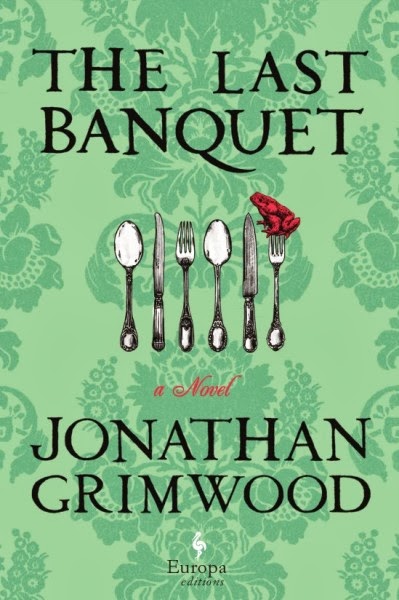
The Last Banquet


Jonathan Grimwood 

The Last Banquet is an intriguing novel. Its canvas is both broad and singularly personal. Jonathan Grimwood's take on pre-revolutionary France is a fascinating, ambitious and altogether brilliant exploration of a unique period in France's history, viewed through the eyes and told from the perspective of a minor noble who starts life in a dung heap and finishes it as master of a sweeping estate and castle in the south of France, one that also doubles as the retirement home of a range of exotic animals no longer fit for life at the Palace of Versailles. The book tells the story of all that comes to pass in between.


Grimwood has written a historical novel that does an exceptional job at not actually reading like a historical novel. A deft illustration, caricature and—at times—skewering of the norms and social customs of France during a period of perverse inequity, brutal injustice and ridiculous class distinctions, it neither lectures or passes judgement. Above all, however, The Last Banquet is a story of life, love, friendship and, particularly, food. Taste is a sensory sub-narrative that weaves through the book, tangential and yet essential to the overall structure. From the sweetness of dung beetles to the richness of roquefort to the fresh sweat at the edge of his first love's neckline, there is no taste left unexplored and unsavoured.


Without question, The Last Banquet is my favourite book so far this year. It is a richly drawn tale of what it means to be human, and to make choices, and to succeed and fail—to live and die—by those choices. But it is a singularly human tale, one that draws you in and doesn't let you go until the absolute and inexorable conclusion. Grimwood's characters are deftly drawn, his dialogue is exceptional and his story telling is superlative. It is Timothy Findley's Famous Last Words, as written by Joanne Harris. And worth the read because of it.

Mark Mullaly is an avid reader, sometimes writer, enthusiastic motorcyclist and lover of wine (and endeavours to engage in only one of these pursuits at any given time).

Last Train to Paris


Michele Zackheim

This novel set in the 1930’s takes us into the mind and heart of a true pioneer. Rose Manon grew up in small town Nevada with a dream to be a journalist in New York City; when she learns of an opening for a reporter at one of the newspapers there, she heads off to start her dream. The Editor had been expecting a male correspondent, but Rose manages to persuade him to give her a chance. As it was in the 30’s, Rose has to prove herself to a higher standard than her male counterparts to gain recognition and respect within the industry. But she soon shows that she has the talent and ambition that it takes to succeed in New York City, and in 1935 starts pursuing an opportunity to take her to Europe.  Before she goes abroad to France in 1937, Rose discovers her ethnicity, a secret her parents had kept hidden from her. 

Once in Paris, reporting for the Paris Courier, Rose meets Leo, a German radical and anti-Nazi, and realizes that, while Paris is an exciting city to live in, the real stories are unfolding across the border in Germany. She manages to get assigned to the Berlin office, where she is happy and in love, until the outbreak of WWII. We are then caught up in the terror, worry and anxiety of Rose’s life as she fights for those she loves. Her mother, a woman she has had a difficult relationship with her whole life turns up in Germany looking for Rose.

This story occurs when Rose is an old lady reliving her memories, living in a different world, but still considered a pioneer of her time. This book is riveting, we can feel the panic and anguish of Rose as she fights for those she loves, the love-hate-duty relationship she has with her mother, and a certain naivety of the times; people outside Germany did not believe the war would happen. Personal and insightful, it should be prescribed reading for young scholars today.

-Catherine McGratton

A Star for Mrs. Blake


April Smith


This is a tremendously emotional novel set in the 1930s about five American women—Gold Star Mothers—who travel to France to visit their soldier sons buried in the Meuse-Argonne American Cemetery near Verdun. For people who have visited one these military cemetery’s in their travels, they will recognize the emotional toll the trip takes on these women. Seeing so many graves of America’s finest youth in one place is overwhelming, and the author has managed to capture the feelings and actions of the women in such a way that the reader feels a part of the story. The women are from different strata of society, from cities and towns and small rural places. We see Europe in the 1930’s through their eyes and are introduced to a journalist badly disfigured in the war who runs a piece on the women in the local newspaper; and just like that, they become minor celebrities overnight. This one act of journalism also provides the novel with the twist in the tail. 
 

A Star for Mrs. Blake is about sacrifice, by the soldiers on behalf of their country, and by the mothers in letting their sons go, but it is primarily a story of women who forge new friendships and come together with each other over a shared tragedy. Death is a great equalizer; money, social status and life experience cannot save us from the grief we feel when we lose a child. The reader is taken through a maelstrom of emotion as the story is told through the eyes of the woman, but you come away feeling uplifted and invigorated with a new-found belief in the human spirit. It’s a great book to read, to remember the sacrifice paid by so many both at home and abroad, those who served and those who waited for their return.

-Catherine McGratton

Tuesday, January 14, 2014

Pheonix Island


John Dixon

While I was looking into Phoenix Island, another review mentioned that you should not start reading this book before bed because it’s too good and you will not want to sleep. I like to live dangerously but I should have taken that person’s advice. This book is so exciting and I couldn’t believe how great the writing was for an author’s first novel. Here's the basics: a government organization takes troubled orphans to an island where they are trained to be ultimate soldiers. I don’t want to go into too much detail about the plot, because I don’t want to give anything away.


I was expecting something like the hugely popular Hunger Games, yet I found this book more captivating and I connected much more to the characters. The television show Intelligence was based on this book, and I am now seriously considering watching the show because the book was just so original and creative. I would like to see how they transform such a fascinating story line into a series. 

I highly recommend this book to anyone who enjoyed The Hunger Games or any type of action/thriller book. This book is hugely suspenseful and I’m telling you not to start this book before bed because you will not be able to put it down! 
Wesley Wilson is a zoology student at the University of Guelph and works on campus at a microbiology lab. When Wesley isn’t studying away, she spends most of her time reading. Anna Karenina is her favourite book, but she enjoys reading a variety of different genres.