Sunday, November 18, 2012

The Green Shore

Natalie Bakopoulos

Greece is a special place, a personal Elysian fields--golden, warm, with air perfumed by the scents of the Mediterranean. Place this paradise in a vice of fear: in 1967, just twenty-three years after Nazi occupation, a military junta brings its might to bear on a populace of “people doing their jobs, not wanting to make a scene.”

Despite the terrible familiarity of “the energy it takes to stay below the radar” and the knowledge that to think is a crime in itself, the more mature characters in Natalie Bakopoulos’s intense first novel, The Green Shore, feel torn by their wishes for liberty, stability, and protection of family and self. Typified by the radical poet Mihalis, their reaction to oppression is to suppress feelings and avoid arrest. The resulting tension becomes unbearable: Mihalis eventually bursts out from his mild expressions of resistance to full-blown confrontation, which in turn leads to his arrest and subsequent torture--all described in an eerie calm of disassociation.

Sisters Sophie and Anna mature personally and sexually, and the novel draws parallels between the unpredictable and explosive qualities of political action and their burgeoning sexual natures. In Sophie’s case the forbidden thrill of political action drives her from the bosom of family and homeland to the cold, rainy haven of Paris. The reunification of the family at the novel’s close provides a further sense of the story as a classic tale. Bakopoulos’s ability to create a compelling family saga in an intriguing oppressive context makes this novel a fascinating read.

- Rosslyn Bentley

Saturday, November 10, 2012

Niceville


Niceville
Carsten Stroud

If Quentin Tarantino and Guy Ritchie co-wrote a supernatural detective story, you'd probably end up with something like Carsten Stroud's Niceville. Titled after its setting, the story begins with the sudden vanishing of a little boy (not a figure of speech—he literally disappears) and the killing of several police officers. The effects of both events spread out, affecting the lives of 21 different characters throughout the course of the story, interconnecting them in a complex web of secrets and conspiracies that have their roots back at the turn of the twentieth century.

I mention Tarantino because of the book’s snappy dialogue. The conversations are quippy and entertaining, effectively holding the reader’s attention. The Ritchie parallel comes from Stroud’s ability to string together so many storylines in ways that interconnect like a fascinating puzzle box, granting multiple eureka moments to readers as we're given tantalizing bits of info with which to try and stitch together our own answers.

It's difficult to classify Niceville as a single genre because the book makes effective use of a cornucopia of different tropes. It's a noir mystery structured like a morbid comedy-of-errors and ridged with a number of increasingly creepy horror elements, with the use of the latter being one of the most impressive features of the book. Stroud makes use of minimalistic, Hitchcock-type storytelling, constantly threatening to show you what's in the bag rather than actually doing it. Vague descriptions and the reader's fear of the unknown do most of the dirty work to produce spine-ascending chills at regular intervals.

If I had any complaints about Niceville, it would have to be the inconsistent characterization. Including 21 fully fleshed-out characters could result in a tome more usable as a murder weapon  than reading material, but several characters feel like rushed, two-dimensional, caricatured plot devices more than actual people. Though Stroud's prose makes them fun nonetheless, switching from the more fully-realized characters to flatter characters was sometimes jarring enough to break my immersion in the book. Despite weighing in at over 400 pages, Stroud’s pacing is brisk enough that hours can pass in a blur while the reader investigates the labyrinthine events of his yarn.

Niceville is an inventive little gumbo of classic narrative elements, strung together in a way that’s creative enough to satisfy even the most cynical of readers. Events and people gradually form a complex web, like clues a crime investigator might pin on a bulletin board and connect with red yarn, stringing you along from one chapter to another. You’ll soon find yourself another 150 pages in and wondering where the time has gone. Well-paced, wittily written, and meticulously thought out, Niceville is definitely worth a look for any fans of horror, noir, comedy, or just plain good writing.

- Vincent Smith


Vincent Smith is a taoist, aspiring writer, and dyed-in-the-wool psychology geek at the University of Guelph. You can find his writing on video games, comics, movies, and all things geek over at The Rogue's Gallery.    

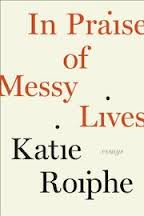
In Praise of Messy Lives

Katie Roiphe

Reading Katie Roiphe is like a drink of Campari and grapefruit, bittersweet and bracing. She’s the sort of person who’d be a good friend, but never your best friend. Thoughtful, considerate, yes, but a little too astringent, a little too willing to be dead honest, a little too sarcastic, a little too ready to see the ridiculous in the things you thought you admired.

Thank goodness we still have essayists, and books of essays; that we haven’t all crawled up the navel of novels, or nonfiction, but still have people like Roiphe dedicated to just writing opinion.

What’s she on about? Pointless babies, American travelers, benighted relationships, Didion, Austen, the incest card, Sontag, Updike, modern urban life, the benighted Internet, being a dominatrix.

There is so much she finds questionable, but so much she wants to appreciate. Her approach/avoidance for everything is one long invigorating tone poem.

- Peter Ferguson

Omnivore's Dilemma


The Omnivore’s Dilemma
Michael Pollan

The Omnivore’s Dilemma demonstrates how disconnected we have become not only from our food but from how and where it is produced. Split into three parts, Michael Pollan’s book first takes us through the rise of corn, a plant that led to human domestication and now permeates every part of our modern lives. He then looks at industrial organic agriculture, how it is practiced, and what the word “sustainable” really means. Finally, Pollan makes the case that food is much more than just calories and nutrients, and explores the idea that we may be missing out on the health benefits imparted by culture and tradition that were once an integral part of our diets. Written as a first-person account of food exploration, with humour and insight, Pollan’s book is as entertaining as it is informative. The Omnivore’s Dilemma will help you to see and appreciate your food in a new way.

- Mark Kubert


Friday, November 2, 2012

Daughters Who Walk This Path


Yejide Kilanko

The path of womanhood is not an easy one. A woman must withstand the heat of oppression under her feet and overcome the obstacles of gender bias ahead. At the same time, detours and derailments can determine a woman’s fate—they can make her either victorious or a victim of circumstance.

Yejide Kilanko’s coming-of-age novel, Daughters Who Walk This Path, introduces us to Morayo, the heroic narrator who indeed walks that path of oppression and gender bias among women in Nigeria. Growing up, Morayo had to deal not only with having an albino for a younger sister, but also with the social and traditional stigmas of femininity imposed by her conservative parents. As she walks this path of womanhood, Morayo is definitely not prepared for the derailment concocted by her cousin, Bros T, and the effect it would have on her in the long run.

But one cannot walk such a hard path alone. Morayo’s cherished aunt, Morenike, befriends her. Morenike has walked a similar path of abuse and shame, but lives to steer Morayo on the road to empowerment.

As a Ghanaian, I can relate to Nigerian conventions, such as conservative parents who favour males over females when it comes to breadwinning. But through Morayo’s obstacles Kilanko does a great job highlighting gender issues in Nigeria. The novel is broken into five parts. Morayo narrates the majority, while Morenike’s account is described in third person. Kilanko does a great job switching from first-person to third; both characters go through the same struggle, but it is Morayo who lives on with the lessons learned.

Daughters Who Walk This Path indeed encourages women to determine whether they will be victors over or victims of the obstacles in their lives.

- Raynika Awotwi

Age of Miracles


Karen Thompson Walker

Waking up on a Saturday morning was never this stressful. Julia and her family in suburban California have recently discovered that something has happened to the earth’s rotation: it has begun to slow. The days are getting longer and longer, birds are dropping out of the sky, and in the midst of global devastation, Julia is coping with the normal catastrophes of ordinary life—changes in her parents’ relationship, problems with her friends, first love, and the struggle to adapt to her new life in an altered world.

I knew I was in love with this book as soon as I read the first sentence. The story just escalated from there. The plot line is so interesting and the writing is so perfectly executed. This book is definitely an original. I love Julia because she’s just trying to manage her life as best as she can under the most unordinary circumstances. I can relate to her so well, not because the earth’s rotation has begun to slow but because she’s struggling with her friends, feelings, and parents. If you want a good read, then I suggest you read this one because this book doesn’t disappoint. Fantastic read!

- Christina Marchese


A Discovery of Witches


Deborah Harkness

This is a book to devour. With a love of mystery, history, fantasy (witches and vampires), and drinking tea, I was caught up immediately in this story, which left me wanting to read the next two parts of Deborah Harkness’s All Souls trilogy as soon as I had finished it.

Harkness weaves a complex tale about Diana Bishop, a witch who has refused to use her abilities since the brutal murder of her magically talented parents. Thrusting herself into her research at Oxford, Diana discovers a historic text, Ashmole 782. With that discovery, she sets loose ripples of power that affect witches, vampires, and demons around the world, setting them all on the lookout for her and the document. She knows that the text is important, but has no idea how or why.

Among those looking for her is the brilliant, centuries-old vampire, Matthew Clairmont. His elegant and sophisticated mannerisms balance out his feral, brutal tendencies, which come from years of fighting in wars and his inherent vampire nature. Using their wit and resources, Diana and Matthew seek to discover the importance of Ashmole 782 and stay alive.

The historical facts that Harkness employs in A Discovery of Witches add a rich level of detail, making the story even more compelling for people who love historical fiction. Tea lovers will find a kindred spirit in Diana and her love of a good cuppa. The only issue I had with reading this book was the desire to drink tea every time Diana did, which was a lot. Readers can continue to follow Diana’s adventures in the second volume of the trilogy, Shadow of Night.

- Lindsay Ly